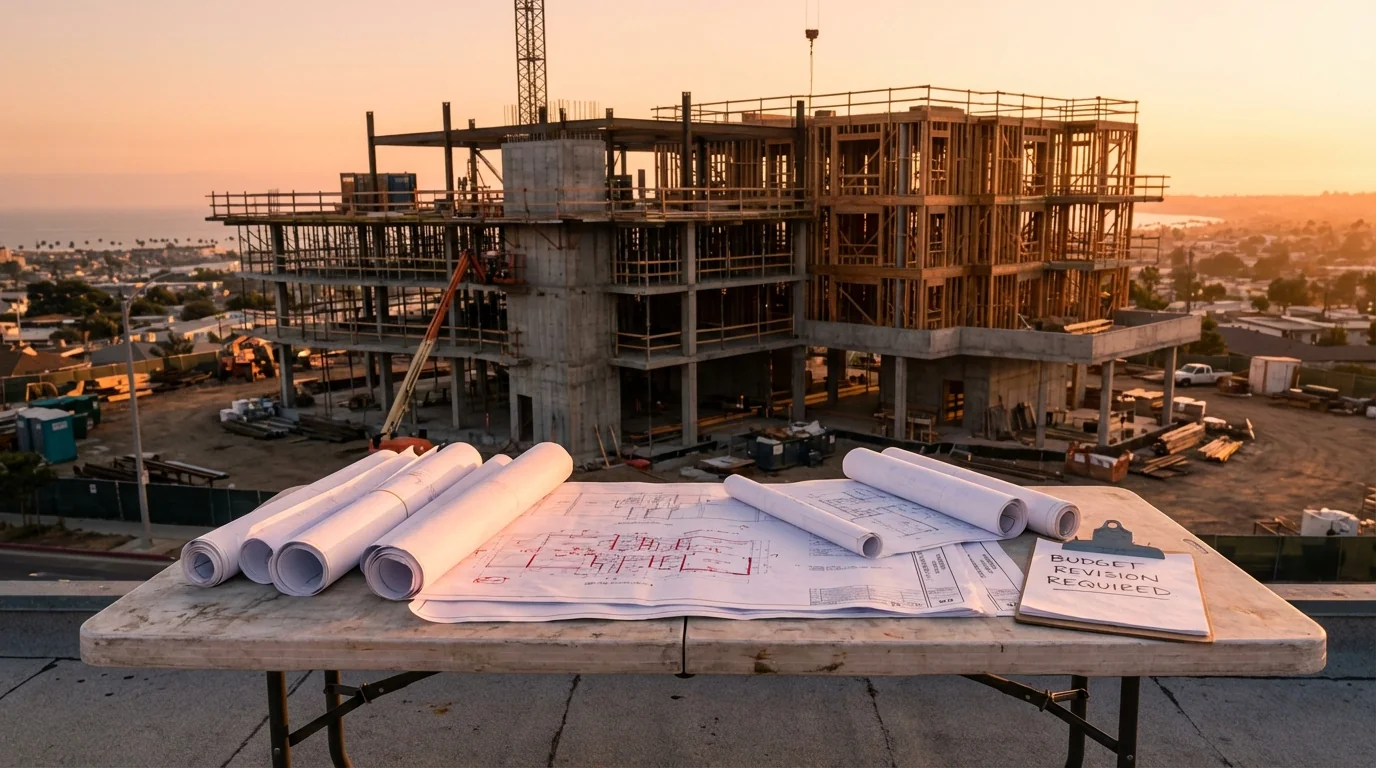
In San Diego development, beautiful drawings don’t guarantee a project pencils.
I see this often: projects designed for the portfolio instead of the built outcome. Renderings are strong. The architecture is compelling. But somewhere along the way, the design drifted away from the financial reality of the site.
And that erosion is quiet.
It happens in small moves — a little more height, a deeper modulation, a material upgrade, an ambitious circulation move — until the pro forma no longer aligns with entitlement, yield, or schedule assumptions.
Design should enhance value. Not destabilize it.
Overdesign isn’t about creativity.
It’s usually a symptom of unclear strategy.
It happens when:
When entitlement clarity lags behind design ambition, every design move adds risk.
Overdesign is not an aesthetic issue. It’s a feasibility issue.
Architecture’s highest value in development isn’t just aesthetics.
It’s:
If height limits, density allowances, Coastal overlays, historic context, parking ratios, or fire access constraints aren’t fully understood, the design can unintentionally overreach.
Every revision cycle triggered by entitlement misalignment adds:
And often, value-engineering later in the process costs more than designing strategically from the beginning.
San Diego is evolving. Legislation like SB 79 is expanding transit-oriented development capacity — increasing allowable height and density near qualifying transit corridors.
That expanded capacity creates opportunity.
But increased entitlement potential does not automatically mean every project should maximize height, FAR, or unit count.
Transit-oriented upzoning still interacts with:
If the team does not fully understand how those layers interact, maximizing density on paper can destabilize cost, complexity, or schedule in reality.
Overdesign risk increases when theoretical capacity is mistaken for practical feasibility.
Tools like AB 253 can help certain small, 1–10 unit, 100% residential projects move more efficiently through building plan check under defined conditions.
But acceleration at building review does not fix flawed early assumptions.
If:
No amount of plan check speed resolves that.
Speed supports strategy. It doesn’t replace it.
Projects designed for the portfolio aim to impress.
Projects designed to pencil aim to build.
That doesn’t mean sacrificing quality. It means aligning:
When strategy leads and design follows, the project becomes resilient.
When design leads without regulatory clarity, risk compounds.
In San Diego, entitlement complexity, overlays, Coastal review, and infrastructure constraints require discipline before creativity.
The strongest projects share a pattern:
Design excellence matters.
But design that aligns with the pro forma — and the entitlement structure — is what gets built.
And projects that get built are the ones that actually create value.
Related reading:
Learn how CEQA risk is created upstream during site selection.
See why the entitlement framework — not design — determines project timelines.
This content is provided for general informational purposes only and does not constitute legal, financial, or entitlement advice. Zoning requirements, overlay constraints, construction thresholds, and entitlement pathways are subject to change and vary based on site conditions, jurisdiction, and agency interpretation. Project feasibility must be evaluated on a site-specific basis in coordination with qualified professionals and the appropriate public agencies.