

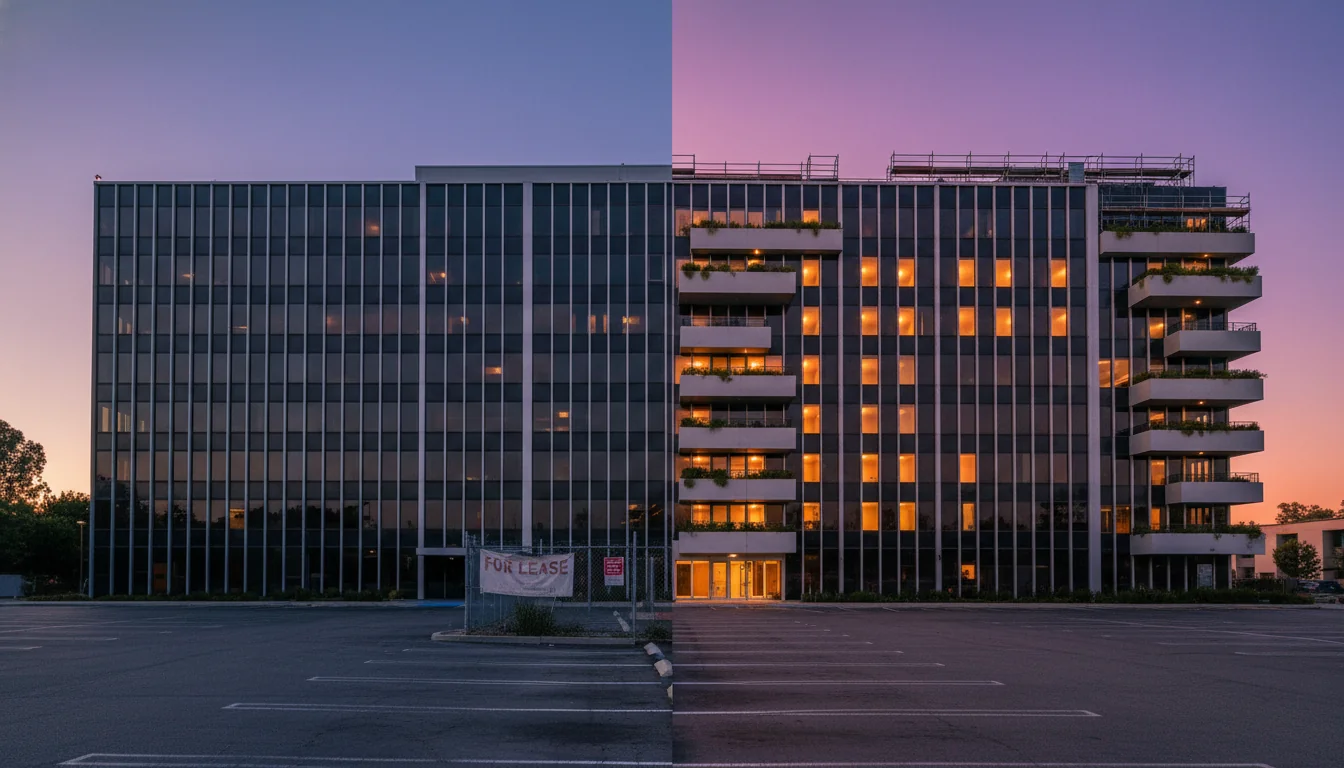
AB 2011 Office-to-Residential: When the Math Works in San Diego
Introduction
San Diego office vacancy is high. Class B and C buildings in particular are bleeding tenants.
Owners with under-leased commercial assets are looking for an exit. Developers are looking for sites they can build on without fighting through a discretionary entitlement.
AB 2011, in effect since 2023, creates a by-right ministerial pathway to convert qualifying commercial sites into multifamily housing. No CEQA. No public hearings. A 60-day or 90-day approval window once the application is complete.
What AB 2011 Actually Does
AB 2011 establishes two ministerial approval tracks for residential development on commercial-zoned land:
- a 100% affordable track for projects on any commercial-zoned site that meets the standards
- a mixed-income track for projects on commercial corridors that meet additional locational criteria
Both tracks require the project to comply with objective design and development standards. Both require prevailing wage. Larger projects also require skilled and trained workforce labor.
Neither track allows discretionary review or CEQA.
Why San Diego Is Well Positioned
Three structural conditions make San Diego an unusually strong AB 2011 market:
- significant inventory of older Class B and C office buildings with motivated owners
- commercial-zoned corridors along El Cajon Boulevard, University Avenue, Convoy, and parts of Sorrento Valley that meet AB 2011 locational criteria
- strong rental demand in submarkets adjacent to the corridors most likely to qualify
The opportunity is not in Class A downtown towers. It is in suburban office parks and aging corridor commercial properties that lost their tenants and never got them back.
Where the Math Works
Office-to-residential is hard. Floor plates were not designed for housing. Plumbing risers are wrong. HVAC was sized for daytime occupancy.
A conversion makes financial sense when:
- the acquisition basis reflects the distressed nature of the commercial asset
- the floor plate can accommodate residential units without massive structural rework
- core, parking, and vertical transportation can be reused
- the AB 2011 ministerial approval eliminates the 12 to 24 months of entitlement risk that a discretionary path would require
The schedule certainty is often the deciding factor. A project that takes 18 months to entitle and 24 months to construct does not pencil. A project that takes 3 months to entitle and 18 months to construct often does.
Where the Math Breaks
AB 2011 is not the answer for every commercial site.
Conversion economics fail when:
- the floor plate is too deep for residential daylight requirements
- the building is on a sensitive site, in a hazardous area, or on a registered industrial use
- the seller is not motivated to price the asset at its actual income basis
- the prevailing wage requirement combined with reconstruction cost exceeds the ground-up alternative on a comparable site
In those cases, demolition and ground-up new construction usually outperforms adaptive reuse.
What We Look At First
When a client brings us a potential AB 2011 site, the first hour of analysis is structural and locational, not regulatory.
We check:
- floor plate depth and column grid against typical unit layouts
- vertical core capacity and plumbing/HVAC reuse potential
- whether the parcel falls inside AB 2011’s commercial corridor or commercial zone criteria
- the project’s eligibility for the 100% affordable track or the mixed-income track
- parking, transit, and AB 2097 overlap, which often eliminates the need for replacement parking
If those check out, the regulatory pathway becomes the easy part of the conversation.
AB 2011 changes which commercial sites are buildable. The buildings that lost their commercial use because the market moved on are exactly the ones the law was designed to convert. The diligence is structural first, regulatory second.
Closing
For two decades, office conversions were a niche product. Now, with vacancy stuck and entitlement risk eliminated by AB 2011, the math has shifted.
The right commercial site at the right basis, on a qualifying corridor, in a transit-adjacent zone, can become a financeable residential project on a timeline that ground-up new construction cannot match.
Related read: The constraint on most San Diego housing is not zoning but feasibility. AB 2011 is one of the levers that changes that. See San Diego Doesn’t Have a Zoning Problem — It Has a Feasibility Problem.
Could your commercial site qualify for AB 2011?
We run paid conversion-feasibility studies that assess the building’s structural fit for residential use, verify AB 2011 eligibility, model the prevailing-wage and affordability cost impact, and quantify the schedule advantage over a ground-up alternative. You get the math before you offer on the asset.
Book a Conversion Consultation →Principal-led. Site-specific. Confidential.
This content is provided for general informational purposes only and does not constitute legal, financial, or entitlement advice. AB 2011 qualification, commercial-zone criteria, prevailing-wage application, structural fit, and conversion economics are subject to change and vary based on site conditions, building characteristics, jurisdiction, and agency interpretation. Project feasibility must be evaluated on a site-specific basis in coordination with qualified professionals and the appropriate public agencies.